
Can You Add Battery Backup to an Existing Solar System?
Can You Add Battery Backup to an Existing Solar System?
Already have solar panels? You may not need to start over to enjoy the benefits of battery storage.
Many Las Vegas and Henderson homeowners invested in solar panels years ago to take advantage of Southern Nevada's abundant sunshine. But as energy needs change, more homeowners are asking a new question:
Can I add a solar battery to the system I already own?
The good news? In many cases, yes!
Adding battery storage to an existing solar system is often possible, even if the original installation wasn't designed for batteries.
However, not every solar system is the same. Understanding your existing equipment is the first step toward finding the right battery backup solution.
Why Add Battery Storage to an Existing Solar System?
Your solar panels generate electricity when sunlight is available. Without battery storage, excess solar energy is typically sent to the utility grid, depending on your system's configuration.
A solar battery gives you another option: storing some of that energy for later use.
Homeowners consider adding battery storage for several reasons:
Backup power during outages: A properly designed battery backup system can help keep selected appliances and essential circuits operating when utility power is unavailable.
More control over solar energy: Store available solar electricity for evening use instead of relying entirely on the grid.
Changing household needs: Your energy priorities may be different today than when your solar panels were first installed.
Potential electricity savings: Depending on your NV Energy rate plan, electricity usage, and system configuration, battery storage may help you manage when you purchase electricity.
Battery storage isn't just for brand-new solar installations. It can also be an upgrade to a system that's already working well.
Do You Need to Replace Your Existing Solar Panels?
Usually, no.
If your solar panels are in good working condition, adding battery storage generally doesn't require replacing the panels themselves.
The bigger question is whether your existing solar equipment can work with a new battery system.
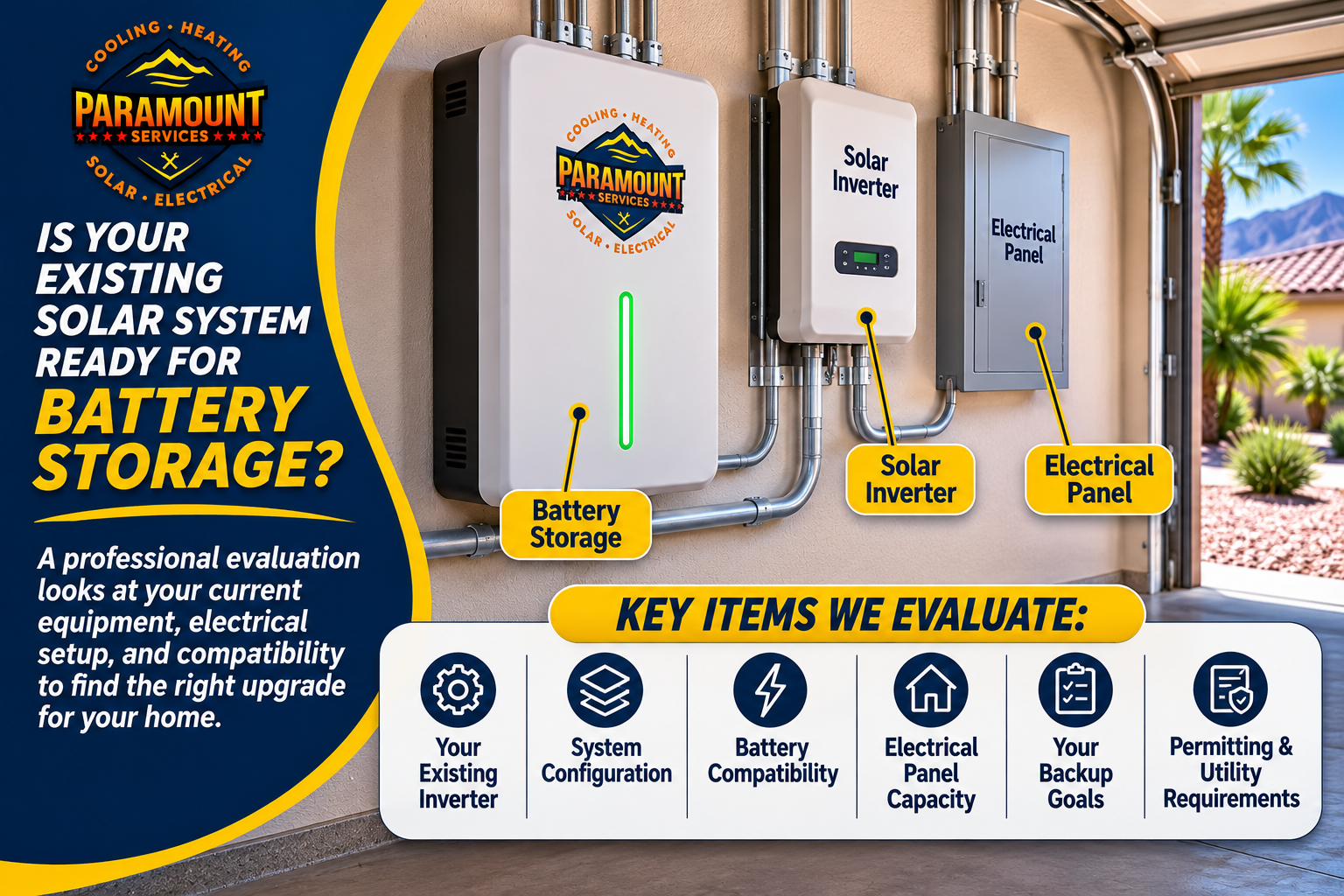
A professional evaluation typically considers:
The brand, model, and age of your solar inverter
Your current solar system's configuration
Your home's electrical panel and available capacity
Battery and inverter compatibility
Your preferred backup circuits
Available installation space
Utility interconnection and permitting requirements
Some systems are already designed to accommodate battery storage. Others may require additional equipment or modifications.
The goal is to work with your existing solar investment whenever practical.
How Can a Battery Be Added to Existing Solar Panels?
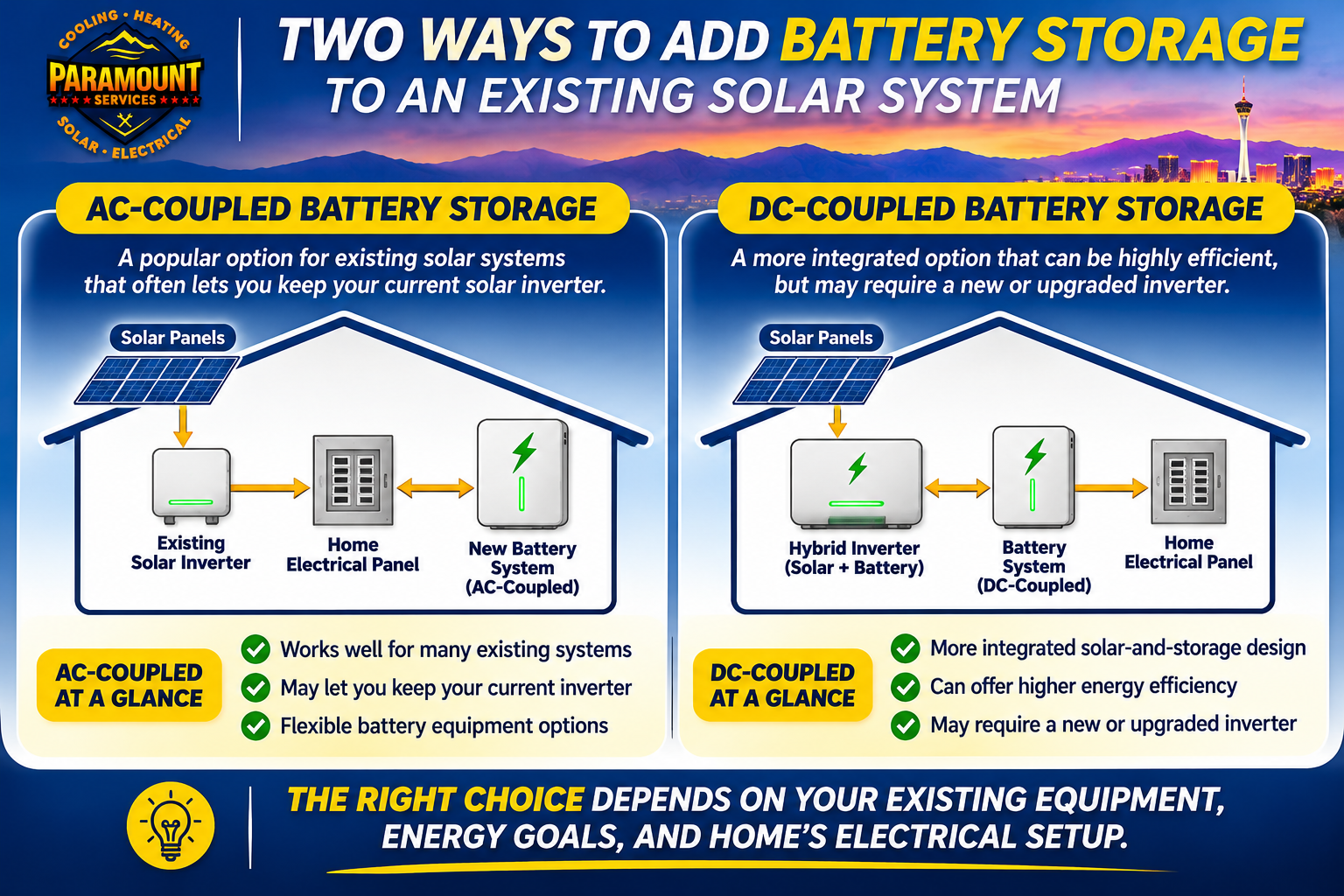
There are two common approaches to integrating battery storage with solar equipment.
Option 1: AC-Coupled Battery Storage
An AC-coupled battery system typically uses separate equipment to manage battery charging and discharging.
In many retrofit installations, this allows homeowners to keep their existing solar inverter.
Why homeowners consider AC coupling:
It can be well suited for existing solar installations.
It may reduce the need to replace functioning solar equipment.
It can provide flexibility when choosing compatible battery equipment.
The tradeoff is that electricity goes through additional conversion steps, which can introduce some efficiency losses.
Option 2: DC-Coupled Battery Storage
A DC-coupled system uses compatible equipment to manage solar generation and battery storage through a more integrated electrical configuration.
This approach can reduce energy conversion losses, but adding it to an existing solar installation may require replacing or modifying the current inverter.
Why homeowners consider DC coupling:
It can offer a more integrated solar-and-storage design.
It may improve energy conversion efficiency.
It may be worth evaluating if an older solar inverter already needs replacement.
Neither approach is automatically the best choice for every home.
The right battery configuration depends on your existing equipment, energy goals, and installation requirements.
Will My Solar Panels Work During a Power Outage?
This is one of the most important details to understand before purchasing a battery.
Most traditional grid-connected solar systems automatically shut down during a utility outage for safety reasons.
Adding a battery doesn't automatically change that.
To provide backup power, your installation needs compatible equipment capable of safely disconnecting from the utility grid and supplying electricity to designated household circuits.
And there's another important distinction:
Not every solar-plus-battery system can continue charging its battery from rooftop solar panels during an outage.
That capability depends on the inverter, battery controls, and overall system design.
Before selecting a battery, ask how your solar panels and battery will operate together when the grid is down.
Can a Solar Battery Power My Air Conditioner?
Living in Southern Nevada means air conditioning is more than a convenience during the summer.
Naturally, homeowners want to know whether a solar battery can keep their cooling system running during an outage.
The answer depends on several factors:
The power requirements of your air conditioning system
The battery's available energy capacity
The battery inverter's power output
The number of batteries installed
Other appliances operating at the same time
Some battery systems can support certain cooling equipment when appropriately sized and configured. Others are designed primarily for smaller essential loads.
For many households, prioritizing refrigerators, lighting, internet equipment, and selected outlets may provide a more practical starting point.
A battery should be sized around what you actually want to power—not simply the size of your solar panel system.
Will Adding a Battery Affect My Existing Solar Warranty or Utility Agreement?
It's worth reviewing your existing solar documentation before making changes.
Depending on your equipment and agreements, adding battery storage could involve:
Manufacturer compatibility requirements
Existing equipment warranties
Solar leases or financing agreements
Electrical permits and inspections
NV Energy interconnection review or approval
Possible implications for existing net metering arrangements
Requirements vary by installation.
A professional evaluation can help identify these considerations before you commit to a battery upgrade.
How Does Paramount Services Help Homeowners Explore Battery Backup?
At Paramount Services, we understand that homeowners have already made a significant investment in their solar systems.
Our goal is to help you understand your options—not assume you need to replace equipment that's still working.
Because we work with battery solutions from multiple manufacturers, we can explore options based on your home's existing equipment and energy needs.
A battery backup evaluation can help determine:
Whether your existing solar system is a candidate for battery storage.
Which equipment and battery configurations may be compatible.
What additional electrical equipment or modifications may be necessary.
Which household circuits you want to support during an outage.
What installation and permitting considerations apply.
Every home is different, and your battery storage solution should reflect that.
Ready to Get More From Your Existing Solar System?
You invested in solar energy for a reason. Adding battery storage may be a way to expand what that investment can do for your household.
Whether your solar panels were installed recently or several years ago, the first step is understanding what's already in place.
Paramount Services helps Las Vegas, Henderson, and surrounding Southern Nevada homeowners explore battery backup options for existing solar systems.
🔋 Interested in adding battery storage to your current solar panels?
Visit www.ParamountServicesLV.com to learn more about our solar services and discuss your options.
Nothing is More Paramount Than Your Comfort.
Continue Our Solar Power Beyond Sunset Series
Missed Part 1?
Solar Battery Backup 101: What Las Vegas Homeowners Need to Know
Coming December 3 — Part 3: Solar Batteries vs. Generators: What's Better for Your Home?
We'll explore how these two backup power options compare, including their advantages, limitations, and important considerations for Southern Nevada homeowners.